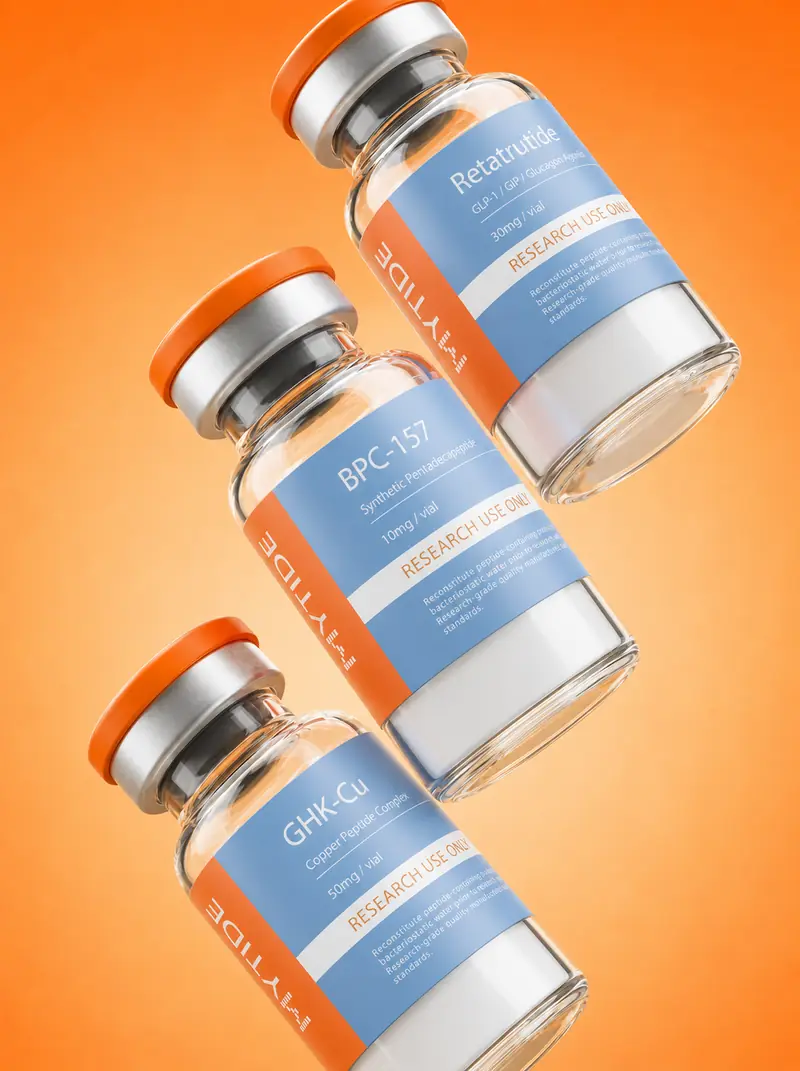
Research materials need a clear handling trail. Storage conditions, reconstitution records, and lot-specific documentation help researchers decide whether a material fits a controlled workflow.
This guide explains what to document for lyophilized and reconstituted materials, including temperature, light exposure, solvent identity, dates, and lot matching. Start with the research peptide catalog, review the reconstitution water product page, and confirm whether a matching record is available in peptide lab reports. The COA reading guide explains how to interpret the files that are actually posted.
The Two States: Lyophilized vs. Reconstituted
The rules for peptide storage change dramatically depending on whether your peptide is still in its freeze-dried (lyophilized) powder form or has been reconstituted in solution.
Lyophilized Peptide Storage
Lyophilization removes water to reduce some degradation pathways. The resulting stability still depends on the compound, formulation, container, and documented storage history.
Temperature records should include:
- The protocol-defined storage range
- Date placed into and removed from storage
- Any recorded temperature excursion
Do not infer a universal shelf life or purity retention from a storage temperature alone. Stability depends on the compound, formulation, container, lot, and documented conditions. Use the supplier's material-specific records and the study protocol rather than treating a generic time range as a guarantee.
Key rules:
- Keep the vial sealed with the original cap or septum
- Store in a desiccated environment (silica gel packets help)
- Minimize freeze-thaw cycles - more on this below
Reconstituted Peptide Storage
Reconstitution changes the material state and should start a new handling record.
Handling records should include:
- The protocol-defined storage range
- Solvent identity and concentration
- Reconstitution date and container identifier
Record the solvent identity, concentration, date, container, and protocol-defined storage window. Do not apply a universal post-reconstitution lifetime across different compounds or formulations. See the reconstitution water product page for the listed composition and the reconstitution guide for documentation considerations.
Temperature: The Most Critical Factor
Temperature is one important handling variable, but the correct range is material- and protocol-specific. The examples below are common laboratory reference points, not a guarantee for every peptide.
-20°C (Freezer) - Best for Long-Term Storage
Freezer conditions may slow some degradation pathways, but they do not halt every reaction or establish a shelf life by themselves. Follow compound-specific documentation.
Tips for freezer storage:
- Use a dedicated freezer (not one that's opened frequently)
- Store vials in a sealed container or zip-lock bag with desiccant
- Label everything clearly with peptide name, lot number, and date stored
-80°C (Ultra-Low Freezer) - For Maximum Preservation
Ultra-low freezers appear in some research protocols. Record the actual range and confirm that it matches the material-specific instructions.
2-8°C (Refrigerator) - For Active Use
Refrigerated conditions are used in many protocols. Confirm the required range and allowed duration in the material-specific workflow.
Room Temperature (~20-25°C) - Avoid When Possible
Room-temperature exposure should be logged because stability varies by compound, formulation, light exposure, and time.
Above 30°C - Rapid Degradation
Unexpected heat exposure can make a handling record incomplete. Procurement review should combine shipment and storage records with lot documentation from the Mytide Lab catalog and lab-report archive.
Light Sensitivity
UV light and even strong visible light can degrade peptides through photo-oxidation. This is especially true for peptides containing:
- Tryptophan - highly susceptible to UV degradation
- Tyrosine - undergoes photo-oxidation
- Methionine - oxidizes to methionine sulfoxide under light exposure
- Cysteine - can form unwanted disulfide bonds
Best Practices for Light Protection
- Store in amber vials when possible (most peptide suppliers use these)
- Wrap clear vials in aluminum foil - simple and effective
- Keep vials in a dark container or drawer when not in use
- Minimize time on the bench - take vials out, draw what you need, and put them back
Even fluorescent laboratory lighting, over extended periods, can contribute to peptide degradation. Don't leave vials sitting out on the bench all day.
Humidity and Moisture
For lyophilized peptides, moisture is the enemy. The whole point of freeze-drying is to remove water - re-introducing moisture kickstarts hydrolysis and aggregation pathways.
Protecting Against Humidity
- Use desiccant packets in your storage container
- Seal vials tightly - check that rubber stoppers are firmly in place
- Don't open lyophilized vials until you're ready to reconstitute
- In humid climates, consider double-bagging with desiccant
- After opening, reconstitute promptly rather than leaving powder exposed to air
The Freeze-Thaw Problem
Every freeze-thaw cycle stresses a peptide. Ice crystal formation during freezing can physically disrupt peptide structure, while thawing creates transient high-concentration zones that promote aggregation.
How to Minimize Freeze-Thaw Damage
For lyophilized peptides: Freeze-thaw cycles are less damaging to dry powder, but they're still not ideal. If you need to use a peptide multiple times:
- Aliquot before freezing - divide the powder into single-use portions
- Only thaw what you need - don't thaw the entire stock to use a small amount
For reconstituted materials: Follow the compound-specific protocol and record every storage-state change. Do not infer an allowed window from a generic guide.
Signs of Peptide Degradation
How do you know if your peptide has degraded? Here are the warning signs:
Visual Indicators
- Cloudiness or turbidity in reconstituted solutions (should be clear)
- Visible particles floating in solution
- Color changes - most peptide solutions should be colorless to very slightly yellow
- Clumping or caking of lyophilized powder (indicates moisture exposure)
- Change in powder texture - should be fluffy and light, not sticky or hard
Performance Indicators
- Unexpected research results - if your peptide suddenly stops working as expected, degradation may be the cause
- Inconsistent results between old and new batches
- Reduced potency requiring higher concentrations to achieve the same effect
When to Test
If storage conditions are uncertain, flag the material for review and verify the available lot documentation:
- HPLC analysis - documents purity percentage and related peaks
- Mass spectrometry - confirms molecular weight against the expected value
- Lot matching - connects the vial, product page, and lab-report archive
Learn how to interpret these results in our COA reading guide.
Storage Quick Reference Chart
| Condition | Lyophilized | Reconstituted (BAC water) |
|---|---|---|
| -80°C | Record freezer, dates, and excursions | Confirm protocol; do not assume |
| -20°C | Record freezer, dates, and excursions | Confirm protocol; do not assume |
| 2-8°C | Confirm material-specific window | Record solvent, dates, and protocol |
| Room temp | Log exposure time and conditions | Log exposure time and conditions |
| Light exposure | Avoid | Avoid |
| Humidity | Protect with desiccant | N/A (already in solution) |
Peptide-Specific Notes
Some peptides have unique storage considerations:
- BPC-157 - Check the listed format and exact-lot documentation; do not infer stability from other BPC-157 lots.
- TB-500 - Record the storage history and review any available lot-specific documentation before interpreting research results.
- GHK-Cu - Document light exposure and compare the vial identifier with the posted lot record when available.
- Tirzepatide and Retatrutide - GLP/GIP-family analogs should be handled with the same documentation-first cold-chain review. Avoid creating duplicate GLP article paths; use product pages and lab reports as the canonical sourcing references.
Key Takeaways
- Follow the material-specific protocol - do not infer a universal temperature or shelf life
- Keep it dark - amber vials or foil wrapping
- Keep it dry - desiccants for lyophilized storage
- Minimize freeze-thaw cycles - aliquot before freezing
- Document reconstitution - solvent, concentration, date, container, and protocol
- Match the lot - compare vial identifiers with the available report
- Quarantine uncertainty - flag incomplete handling records for review
Storage records do not prove identity or purity, but they preserve context for interpreting research results. COA and lab-report availability is lot-specific; a catalog listing should not be read as proof that every current lot has a posted report.
For research-use sourcing, start with the Mytide Lab catalog, then verify the matching documentation in lab reports and the COA reading guide. If reconstitution is part of the workflow, review reconstitution water and the reconstitution guide before handling.
Peptide-specific sourcing checks should use the canonical product catalog, individual product pages, and lab-report index, where availability is always lot-specific.