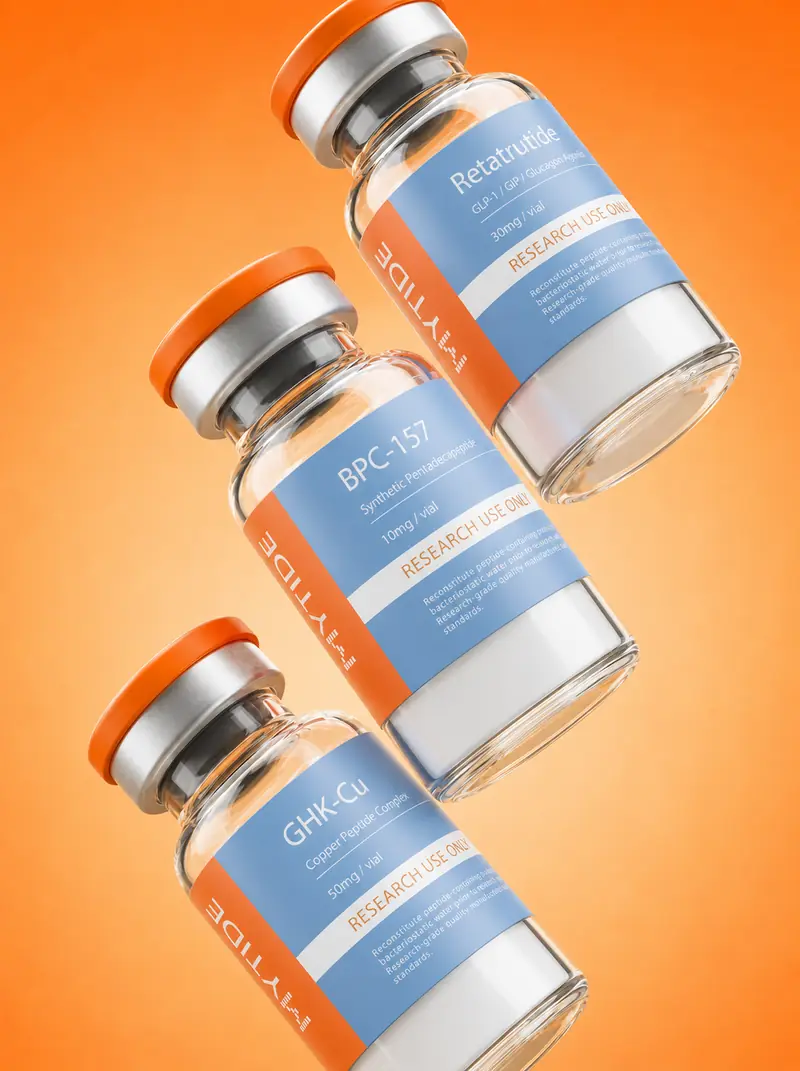
If a lab receives a vial of lyophilized (freeze-dried) research peptide powder, the first question is not clinical use. It is documentation: what solvent is appropriate, what concentration is being prepared, and whether the vial identity matches the Certificate of Analysis.
This guide keeps the process research-use-only. Before mixing anything, cross-check the product page, exact-lot COA when available, and lab-report record. Start with the Mytide Lab Reconstitution Water specifications, then verify the relevant item in the research peptide catalog, lab reports library, and COA reading guide.
What You'll Need
Before you start, gather these supplies:
- Lyophilized research peptide vial - verify the vial label against the relevant product page and lab-report entry
- Bacteriostatic water (BAC water) - sterile water containing 0.9% benzyl alcohol as a preservative; see Mytide Lab Reconstitution Water
- Syringes - insulin syringes (1mL) work well for precise measurement
- Alcohol swabs - for sterilizing vial tops
- A clean workspace - ideally a flat, well-lit surface free from contaminants
Why Bacteriostatic Water?
You have two main options for reconstitution solvent:
Bacteriostatic water contains benzyl alcohol as a preservative. That ingredient alone does not establish a universal post-mix storage window for every compound or protocol.
Sterile water has no preservative. Whether it is appropriate, and how long a prepared sample remains usable, must come from the approved protocol and compound-specific documentation.
Do not treat one solvent as universally interchangeable across peptides. Confirm solvent compatibility against the approved protocol and compound documentation before proceeding. The Reconstitution Water product page lists the available vial format and composition; it does not replace compound-specific handling instructions.
The Reconstitution Calculation
Before adding water, you need to figure out your desired concentration. Here's the simple formula:
Amount of water (mL) = Peptide amount (mg) ÷ Desired concentration (mg/mL)
Example
Say a lab is documenting a 5mg research peptide vial, such as BPC-157, and needs a concentration of 2.5mg/mL for an approved research protocol:
- 5mg ÷ 2.5mg/mL = 2mL of BAC water
Another common setup: 10mg vial, desired concentration of 5mg/mL:
- 10mg ÷ 5mg/mL = 2mL of BAC water
Quick Reference Table
| Peptide Amount | Water Added | Concentration |
|---|---|---|
| 5mg | 1mL | 5mg/mL |
| 5mg | 2mL | 2.5mg/mL |
| 10mg | 2mL | 5mg/mL |
| 10mg | 5mL | 2mg/mL |
Documentation note: Higher concentrations mean smaller measured volumes, which can increase measurement error. Record the target concentration, solvent volume, date, and batch identifier before any lab handling begins.
Step-by-Step Reconstitution Process
Step 1: Prepare Your Workspace
Clean your work surface with isopropyl alcohol. Wash your hands thoroughly or wear nitrile gloves. Lay out all your supplies so everything is within reach.
Step 2: Let the Peptide Reach Room Temperature
If the peptide vial has been stored frozen, let it equilibrate at room temperature for about 15-20 minutes before reconstitution. Sudden temperature changes can affect peptide stability and make documentation harder to interpret.
Step 3: Sterilize the Vial Tops
Use an alcohol swab to wipe the rubber stopper on both the peptide vial and the BAC water vial. Let them air dry for a few seconds.
Step 4: Draw the Bacteriostatic Water
Using a clean syringe, draw up the calculated amount of BAC water. Remove air bubbles by tapping the syringe gently and pushing the plunger slightly.
Step 5: Add Water to the Peptide Vial
Here's the most important part: inject the water slowly down the inside wall of the vial. Do NOT squirt it directly onto the powder. Direct force can damage peptide bonds and degrade the compound.
Aim the needle at the glass wall near the top, and let the water trickle down gently to meet the powder at the bottom.
Step 6: Let It Dissolve - Don't Shake
Once the water is in, do not shake the vial. Aggressive agitation can denature the peptide. Instead:
- Let the vial sit for 2-3 minutes
- Gently swirl the vial in a slow circular motion
- If powder remains, tilt the vial at a 45-degree angle and roll it between your fingers
Dissolution time and expected appearance can vary by compound, concentration, solvent, and protocol. Appearance alone cannot verify identity, purity, or stability. If the sample differs from the documented expectation, quarantine it and check the COA guide, matching lab-report record, and protocol before continuing.
Step 7: Label Your Vial
This sounds obvious, but label the vial immediately with:
- Peptide name
- Concentration (mg/mL)
- Date of reconstitution
- Volume remaining
This protects chain-of-custody records when multiple research vials are stored in the same cold environment.
Storage After Reconstitution
Once reconstituted, follow the compound- and protocol-specific temperature, light, freeze-thaw, container, and discard-window requirements. Do not infer a universal 28-day or 24-48-hour window from the solvent alone.
Record the storage condition, preparation time, solvent lot, peptide lot, concentration, and protocol-defined review or discard date. For supporting documentation, use the peptide storage guide, Reconstitution Water specifications, and lab reports library.
Common Mistakes to Avoid
Squirting water directly onto the powder. This is the #1 mistake. Always aim for the vial wall and let the water slide down gently.
Using an undocumented mixing method. Peptides vary, and the approved protocol should define the acceptable handling method. Record any deviation instead of assuming one method applies to every compound.
Using a solvent not specified by the protocol. Confirm solvent identity, composition, lot, and compatibility before preparation.
Not calculating concentration beforehand. Once you add the water, you can't take it back. Double-check your math before adding solvent.
Applying a generic storage window. Use the protocol and compound documentation rather than carrying a temperature or discard date from one peptide to another.
Frequently Asked Questions
Can I reconstitute with saline instead of BAC water?
Solvent choice is compound- and protocol-specific. Do not substitute saline, BAC water, or sterile water based on a general guide. Check the approved protocol and product documentation first.
How do I know if my reconstituted peptide has gone bad?
Appearance may flag a deviation, but it cannot establish identity, purity, sterility, or stability. Quarantine any sample that differs from the protocol-defined expectation, then cross-check the COA reading guide, matching lab report, and product documentation.
Can I re-freeze a reconstituted peptide?
Generally, it is not recommended for lab handling. Freeze-thaw cycles can damage peptide integrity. For longer-term storage planning, keep the peptide in its original lyophilized form and only reconstitute the amount required by the approved research protocol.
Does the amount of BAC water matter?
Yes - it determines your concentration. More water means a more dilute solution (which can be easier to measure but requires larger volumes). Less water means a more concentrated solution. Choose based on the approved research protocol, measurement tolerance, and documentation requirements.
Wrapping Up
Peptide reconstitution is a documented lab workflow, not a universal recipe. The key takeaways:
- Verify the peptide and solvent lot against available documentation
- Confirm solvent compatibility in the approved protocol
- Calculate and record the target concentration before preparation
- Follow the compound-specific mixing and storage method
- Use a protocol-defined review or discard window, not a generic 28-day rule
For product and documentation routing, use canonical commercial and trust pages rather than duplicate how-to variants: research peptide catalog, reconstitution water, BPC-157, PT-141, Selank, lab reports, and the COA reading guide.
Need supplies and batch documentation before planning a research workflow? Review Mytide Lab Reconstitution Water, browse the research peptide catalog, and verify the matching lab reports. Keep all use research-only and documentation-led.