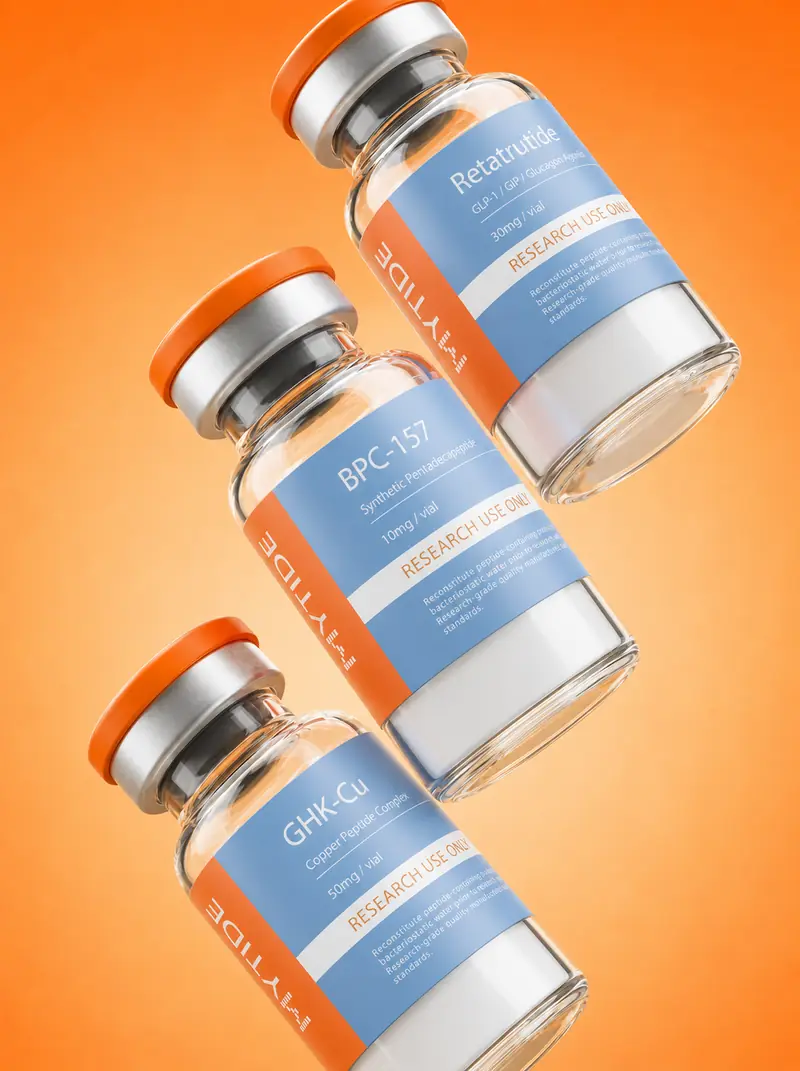
The practical difference in a GLOW vs KLOW peptide blend comparison is usually one component: KLOW commonly adds KPV to the three-compound GLOW formula. That simple summary is useful, but it is not enough for procurement or experimental planning. GLOW and KLOW are market names, not standardized pharmacopoeial formulas. Two products carrying the same blend name can differ in component amounts, total vial quantity, excipients, analytical coverage, and lot documentation.
For that reason, researchers should compare the actual label and batch records rather than treating the acronym as a complete specification. Mytide Lab's current GLOW Blend product page, checked September 28, 2026, lists GHK-Cu, BPC-157, and TB-500 in a 70 mg vial format. Mytide does not currently list a KLOW product, so references to KLOW below describe common market naming rather than a Mytide formulation.
All materials discussed here are for laboratory research use only. They are not for human or animal consumption, medical use, or therapeutic application.
GLOW vs KLOW at a Glance
The most common composition pattern looks like this:
| Comparison point | GLOW blend | KLOW blend |
|---|---|---|
| Commonly listed components | GHK-Cu, BPC-157, TB-500 | GHK-Cu, BPC-157, TB-500, plus KPV |
| Number of components | Three | Four |
| Main formulation difference | Base three-component blend | Addition of the KPV tripeptide |
| Standardized formula? | No | No |
| What must be verified | Per-component quantities, total quantity, lot identity, purity method, report scope | The same items, plus the identity and quantity of KPV |
This table describes a naming convention, not a universal recipe. A vendor may change the relative amounts while retaining the same blend name. Even the meaning of “TB-500” can require clarification because commercial usage does not always distinguish consistently between thymosin beta-4, fragments, and supplier-specific naming. The product label, sequence or identity information, and lot-level analytical documents control the comparison.
Explore Mytide's GLOW Blend Research Product
Review the current composition, vial format, and available documentation on the Mytide GLOW Blend research product page.
For laboratory research use only. Not for human or animal consumption.
What the Three GLOW Components Represent
GLOW blends are generally built around three chemically distinct research materials. Their inclusion in one vial does not make them a single molecule; each component retains its own identity, stability considerations, and analytical challenges.
GHK-Cu
GHK-Cu is the copper complex of the tripeptide glycyl-L-histidyl-L-lysine. Its published literature includes cell-signaling and tissue-remodeling research. A review indexed by PubMed describes GHK's copper-binding behavior and summarizes multiple remodeling-related pathways, but a blend label alone cannot confirm the amount, copper association, or purity of the material in a particular vial. Researchers comparing formulas should confirm how GHK-Cu is named and measured in the product documentation. See the GHK-Cu research product page and the PubMed review of GHK and tissue remodeling for separate commercial and literature context.
BPC-157
BPC-157 is a 15-amino-acid synthetic peptide that appears primarily in preclinical literature. Recent systematic and narrative reviews emphasize that the evidence base remains dominated by laboratory and animal-model work, with limited and non-standardized human data. In a blend comparison, the relevant procurement questions are identity, sequence, amount, purity method, and lot traceability—not broad claims about outcomes. Mytide lists standalone specifications on its BPC-157 research product page, while a 2025 systematic review indexed by PubMed summarizes the limitations of the published evidence.
TB-500
TB-500 is a commercial research name associated with thymosin beta-4-related material. Because terminology can vary, the exact identity represented by “TB-500” should be verified rather than inferred from the blend acronym. The expected sequence or molecular identity, the reported test method, and the document's connection to the lot all matter. Mytide's standalone TB-500 research product page provides the current catalog route for its product specifications.
The three components also create a testing problem: an HPLC purity value for a finished blend is not automatically the same thing as independent identity and quantity confirmation for every component. Researchers should read the test scope closely.
What KPV Adds to a Common KLOW Formula
KLOW is commonly described as the GLOW base plus KPV. KPV is the tripeptide lysine-proline-valine and corresponds to the C-terminal 11–13 fragment of alpha-melanocyte-stimulating hormone. Published cell studies have examined KPV signaling separately from GHK-Cu, BPC-157, and thymosin-related materials. For example, a PubMed-indexed study evaluated alpha-MSH, KPV, and related peptides in human keratinocyte cell systems.
That separate literature is the key distinction: adding KPV introduces another defined research variable. It does not automatically prove that the four-component mixture has been validated as a combined formulation, nor that findings from isolated KPV experiments transfer to a KLOW vial. Researchers should distinguish among:
- evidence for an individual component;
- evidence for two or more components tested together;
- analytical confirmation of a finished commercial blend; and
- marketing statements about the blend as a whole.
Those are different evidence categories. The KPV complete research guide provides additional Mytide educational context, and the PubMed-indexed keratinocyte study documents one example of component-level KPV research.
The Most Important Research-Design Tradeoff
A single blended vial reduces the number of separate materials in a workflow, but it also reduces experimental flexibility. When several compounds are fixed in one formulation, a study cannot vary one component independently without changing the whole blend. This has several consequences:
- Attribution: If an endpoint changes, the blend alone does not identify which component was responsible.
- Controls: A rigorous design may require the complete blend, the base blend, individual components, vehicle controls, and concentration-matched comparisons.
- Ratios: Fixed component ratios may not match the question being studied.
- Stability: Each component can have different degradation pathways, so the least stable component may determine the useful handling window.
- Analysis: Confirming identity and quantity for several peptides in one matrix can be more complex than testing a single compound.
For a GLOW vs KLOW comparison specifically, an informative design would treat KPV as the added variable while keeping the other three components and their quantities matched. If the products come from different vendors or use different ratios, the comparison introduces additional confounders and is no longer a clean test of KPV's presence.
Why Blend Names Are Not Specifications
The terms GLOW and KLOW are convenient shorthand, but shorthand can hide differences that matter. Before treating two vials as equivalents, compare:
- the full ingredient list;
- the stated amount of every component;
- total vial quantity;
- peptide sequence or molecular identity information;
- counterions, salts, carriers, or other excipients when disclosed;
- lyophilized versus other presentation formats;
- lot number and manufacture or test date;
- identity methods, such as mass spectrometry when included;
- purity methods, such as HPLC when included;
- whether the report tests the finished blend or only source ingredients;
- storage conditions tied to the actual product; and
- the document's match to the vial and lot under review.
A generic “99% purity” statement does not answer all of these questions. It may not say whether every component was identified, whether the reported percentage applies to one ingredient or the finished mixture, or whether the record belongs to the current lot. The Mytide lab reports directory separates published documentation from records that are not currently available, and the guide to reading a peptide COA explains how to review lot identity, method, date, and reported result.
How to Compare GLOW and KLOW Documentation
Use a repeatable review process rather than choosing by acronym or peptide count.
1. Transcribe the formula exactly
Record each named component and the amount attributed to it. Do not rely only on the total vial quantity. A 70 mg or 80 mg total does not reveal the internal ratio.
2. Match the vial to the report
Confirm that the product name, lot number, and date on the vial or listing agree with the analytical record. If the document has no lot connection, treat it as general information rather than proof for the material in hand.
3. Separate identity from purity
Identity testing asks whether the expected material is present. Purity testing asks how much of the detected material is represented by the target relative to measured impurities under the stated method. A blend comparison benefits from both, but they are not interchangeable.
4. Check whether every component was evaluated
A finished blend may require methods capable of resolving multiple peptides. A single chromatographic result without clear peak assignments may not establish the amount or identity of each component. Look for explicit reporting rather than assuming one summary number covers the entire formula.
5. Use product-specific handling instructions
Do not copy storage or post-reconstitution limits from an unrelated vendor, a standalone ingredient, or a different blend. The specific lot documentation and a validated laboratory protocol should control. Mytide's peptide storage guide describes the variables a protocol should document without substituting a universal handling rule.
Which Blend Is “Better”?
There is no research-independent answer. KLOW is not automatically superior because it contains a fourth component, and GLOW is not automatically preferable because it is simpler. The better fit is the formulation that matches a defined research question while minimizing uncontrolled variables.
GLOW may be the cleaner design when the study specifically concerns the three-component formula and does not require KPV as an independent variable. KLOW may be relevant when KPV is intentionally part of the hypothesis and the protocol includes controls capable of separating its contribution. In either case, a standalone component design may be more appropriate when mechanistic attribution matters more than convenience.
Mytide's current commercial route is the three-component GLOW Blend. This guide does not imply that Mytide offers KLOW, that supplier formulas are interchangeable, or that a commercial blend has a clinically established use.
Frequently Asked Questions
What is the main difference between GLOW and KLOW peptide blends?
In common supplier naming, GLOW combines GHK-Cu, BPC-157, and TB-500. KLOW usually uses the same three-component base and adds KPV. Because these names are not standardized formulas, verify the exact ingredient list and per-component quantities for the specific product.
Is every GLOW or KLOW blend formulated the same way?
No. Suppliers may use different component quantities, total vial sizes, excipients, source materials, and analytical methods while using the same blend name. Compare the label and lot documentation, not just the acronym.
Does Mytide Lab sell a KLOW blend?
Mytide Lab's catalog currently lists a GLOW Blend containing GHK-Cu, BPC-157, and TB-500. Mytide does not currently list KLOW as a product. KLOW is discussed here to clarify a common comparison query.
What should a researcher verify before comparing peptide blends?
Verify the full formula, quantity of each component, total vial quantity, lot number, identity method, purity method, report date, testing scope, storage instructions, and the connection between the report and the exact vial under review.
Does a blend COA prove each component was tested?
Not necessarily. The answer depends on the methods and reporting. Review whether the document identifies each component, resolves the relevant peaks or masses, reports per-component quantities when claimed, and clearly ties the results to the finished blend and lot.
Bottom Line
The useful answer to “GLOW vs KLOW peptide” is not simply three peptides versus four. GLOW commonly contains GHK-Cu, BPC-157, and TB-500; KLOW commonly adds KPV. But the blend name does not establish the ratio, identity, purity, stability, or documentation quality of a specific vial.
For reproducible research, start with the hypothesis, then compare exact formulas and lot-level evidence. If KPV is the variable of interest, control for it directly. If the three-component GLOW formulation matches the research question, adding another component may create complexity rather than clarity. In every case, verify the product and its documentation before treating two supplier formulas as equivalent.